
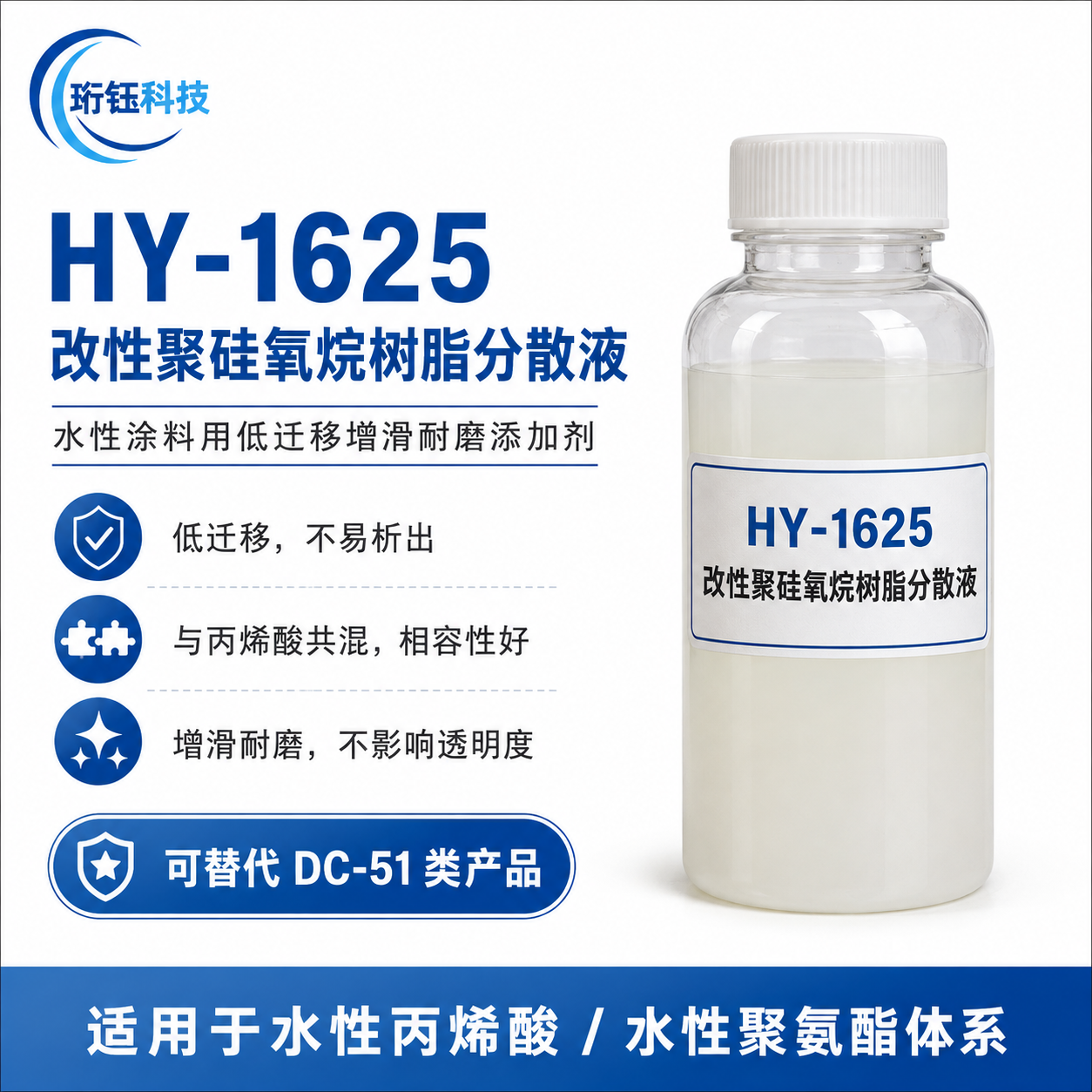
HY-1625 Modified Polysiloxane Resin Dispersion
Low-migration slip and wear-resistance additive for waterborne coatings
HY-1625 is a water-carried modified polysiloxane resin dispersion, mainly used in waterborne acrylic, waterborne polyurethane and their blend coating systems. The product combines the slip, wear resistance and anti-blocking properties of high-molecular-weight silicones, and its resinification modification improves the compatibility between the polysiloxane and the film-forming resin.
Compared with conventional high-molecular-weight PDMS aqueous dispersions (DC-51 type products), HY-1625 blends more uniformly in acrylic systems and shows a low migration and low exudation tendency after film formation, reducing problems such as surface oil spots and flooding caused by silicone enrichment; at compatible formulations and recommended dosages it maintains film transparency and gloss, making it suitable for clear and high-gloss coatings.
Benchmark product: DOWSIL™ 51 type slip and wear-resistance additive, and it is more stable in acrylic systems
Features and Benefits
- •Slip Enhancement and Friction Reduction:Significantly improves the slip and feel of the coating film
- •Wear and Scratch Resistance:Improves friction resistance, scratch resistance and service durability
- •Anti-Blocking:Reduces the risk of blocking during stacking, winding and at high temperatures
- •Low Migration:Not prone to continuous migration or surface exudation after film formation
- •Good Resin Compatibility:Easily blended with waterborne acrylic, polyurethane and their blend systems
- •Transparency Retention:Does not noticeably affect transparency or gloss at the recommended dosage
Composition
- •Modified polysiloxane resin aqueous dispersion
- •Water as the dispersion medium
- •Anionic type
- •Solid content: 25 ± 1%
- •Appearance (25℃): milky to whey-colored liquid
- •VOC: none
| Appearance (25℃) | Milky to whey-colored liquid |
| Main Component | Modified polysiloxane resin aqueous dispersion |
| Ionic Character | Anionic |
| Solid Content | 25 ± 1% |
| Dispersion Medium | Water |
| VOC | None |
Applications
HY-1625 can be used to reduce the coefficient of friction, prevent blocking and improve wear resistance, and is suitable for the following waterborne systems:
Clear and high-gloss coatings:
- •Waterborne acrylic clear coatings, recommended dosage 1.0–3.0%
- •Waterborne clear overprint varnishes, recommended dosage 1.0–3.0%
Blended resin systems:
- •Waterborne polyurethane/acrylic blend coatings, recommended dosage 1.0–3.0%
Functional coatings:
- •Wood coatings
- •Plastic film coatings
- •Metal and paper coatings
- •Waterborne inks and overprint varnishes
- •Leather top coats
- •Waterborne textile printing binders
- •Peelable protective film systems
Main functions:
Reduce the coefficient of friction
Improve wear resistance
Improve anti-blocking performance
Maintain transparency and gloss
Usage Recommendations
- •Recommended to be added slowly in the late stage of paint preparation, stirring at low to medium speed until uniform
- •It can also be pre-mixed with waterborne acrylic resin before addition
- •For clear systems, it is recommended to start with a low dosage and evaluate in a gradient
- •Before bulk use, verification of compatibility, storage stability and film-forming performance is recommended
Packaging and Storage
- •Packaging:50 kg, 100 kg and 200 kg plastic drums
- •Shelf Life:6 months under sealed conditions in the original packaging
- •Storage Conditions:Store in a cool, dry and well-ventilated place, away from direct sunlight, high temperatures and freezing; reseal promptly after use
Compared with conventional DC-51 type products, HY-1625 blends more uniformly in acrylic systems, has low migration and low exudation after film formation, and is better suited to clear and high-gloss waterborne coatings.
Note:The conclusions on low migration and transparency retention are based on the company's existing compatible formulation tests. Different resins, pigments and fillers, additives and application conditions may affect the results; before bulk use, verification of compatibility, storage stability and film-forming performance should be carried out.