
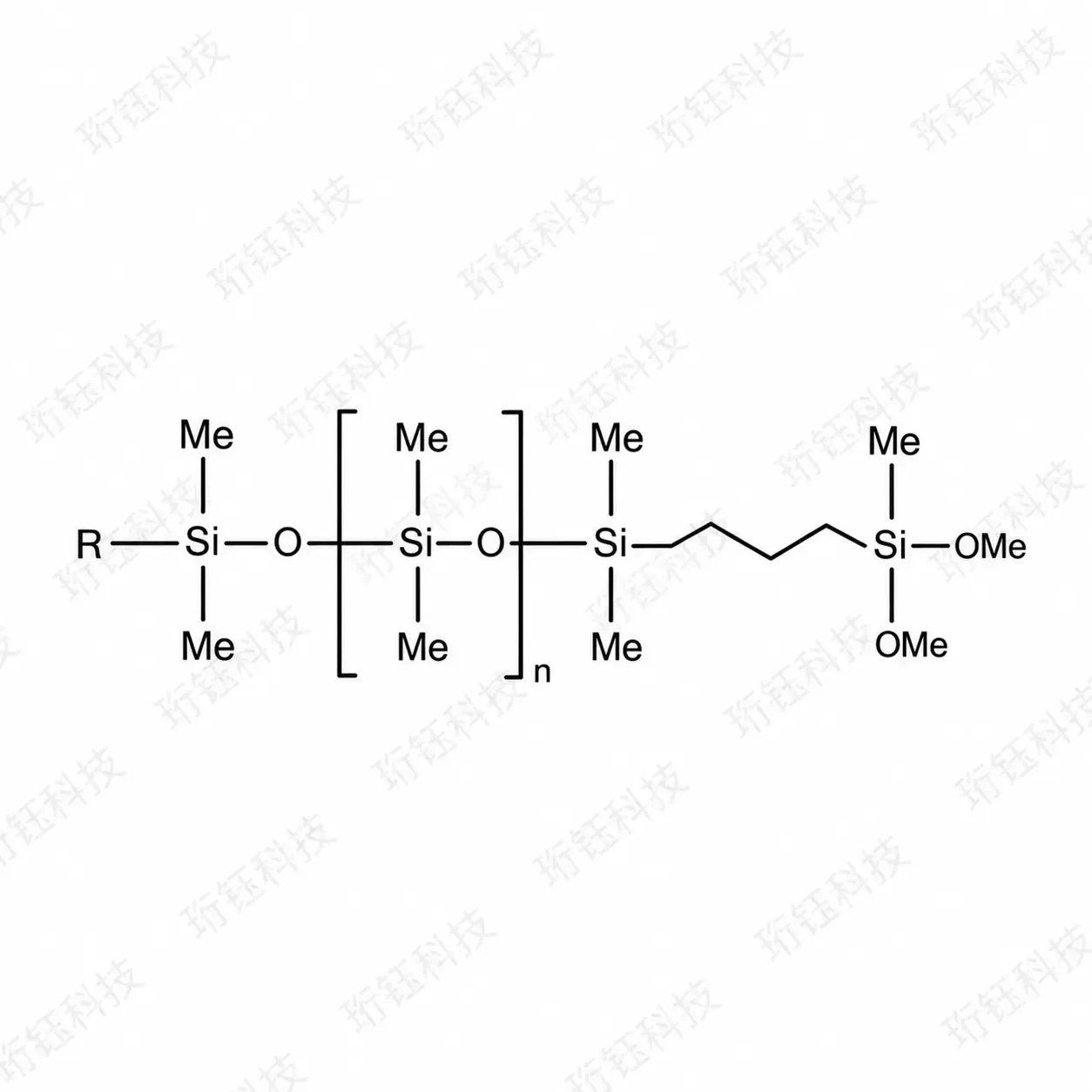
ZG-SDMOS Mono-End Dimethoxy Polydimethylsiloxane
ZG-SDMOS contains a hydrolyzable dimethoxysilane group at one end of the molecule, with the other end being a non-reactive capping group. Under moisture and suitable catalysis, the terminal dimethoxysilane group can hydrolyze to form silanol and undergo condensation with hydroxyl groups on inorganic substrates and filler surfaces or with other condensable silane groups in the formulation, forming stable siloxane bonds. Compared with mono-end trimethoxy models, the dimethoxy end group has relatively milder reactive sites and makes it easier to control the degree of condensation. PDMS segments can provide a certain degree of flexibility, hydrophobicity, low surface energy and stress relief, suitable for filler/substrate surface modification, interface coupling and formulation reaction control.
Product positioning: mono-end moisture-reactive silicone interface/end-group modifier for introducing PDMS flexible hydrophobic segments in filler and inorganic substrate surface treatment, sealing systems and flexible silane formulations, and for controlling the degree of hydrolysis-condensation
Chemical Type
Mono-end dimethoxysilane-terminated PDMS
Functional Structure
Mono-end -Si(CH₃)(OCH₃)₂; the other end non-reactive capping
Reaction Type
Hydrolysis-condensation; surface hydroxyl condensation/end-group reaction
Product Form
Colorless transparent liquid
Product Features
Moisture-Reactive End Group
The terminal dimethoxysilane group can hydrolyze to form silanol under suitable conditions and participate in interfacial bonding, grafting or moisture reactions through condensation
Easier Control of Condensation Degree
Compared with the trimethoxy end group, the dimethoxy reactive site is relatively milder, better suited to formulations requiring control of the hydrolysis/condensation rate and reduced tendency for overly fast pre-condensation
Filler and Interface Modification
Helps improve the wetting, dispersion and interfacial compatibility with resins of inorganic fillers such as silica, alumina and glass fiber
PDMS Flexible Segment
Provides a certain degree of hydrophobicity, low surface energy, flexibility and stress relief; 1500/2000 emphasize higher end-group density and low viscosity, while 2500/3000 emphasize flexibility and PDMS segment effects
Typical Technical Specifications
| Model | Nominal Mn (g/mol) | Appearance | Viscosity (25°C, mPa·s) | Methoxy Equivalent (g/eq) | Methoxy Content (mmol/g) |
|---|---|---|---|---|---|
| ZG-SDMOS-1500 | 1500 | Colorless transparent | 17 | 775 | 1.29 |
| ZG-SDMOS-2000 | 2000 | Colorless transparent | 26 | 1000 | 0.99 |
| ZG-SDMOS-2500 | 2500 | Colorless transparent | 27 | 1250 | 0.80 |
| ZG-SDMOS-3000 | 3000 | Colorless transparent | 28 | 1500 | 0.67 |
*Methoxy equivalent and methoxy content are typical measured values; nominal Mn is a grade reference. The actual batch is subject to the COA.
Applications
| Application System | Recommended Dosage/Metering Principle |
|---|---|
| Inorganic Powder/Filler Surface Treatment | Determined by lab trial according to powder surface area, surface hydroxyl and target coverage |
| Glass, Silica and Metal Oxide Surface Modification | Determined by lab trial according to substrate area and treatment process |
| Reactive Modification of Sealants/Adhesives | Designed according to the base moisture-curing formulation and end-group reaction requirements |
| Coatings, Composites and Flexible Silane Systems | Determined by lab trial according to resin solids, inorganic phase ratio and target performance |
Compatibility and Solubility
| Category | Notes |
|---|---|
| Resin/organic phase compatibility | Compatibility is affected by PDMS molecular weight, non-reactive end-group structure, base resin polarity and dosage; transparency, separation and viscosity lab trials are recommended at the actual formulation concentration |
| Inorganic phase suitability | Supports surface treatment of inorganic fillers/substrates such as silica, alumina and glass fiber; actual wetting and coverage also depend on specific surface area, surface hydroxyl, particle size and treatment method |
| Moisture sensitivity | Direct contact with water or high-water-content systems is not recommended during storage or pre-mixing. If hydrolysis is required by the process, water should be added in a controlled manner and used immediately upon preparation to avoid premature pre-condensation |
| Selection principle | 1500/2000 have lower viscosity and higher methoxy density, prioritizing low-viscosity operation and interfacial reaction efficiency; 2500/3000 have lower methoxy density and emphasize flexibility and PDMS segment effects |
Reaction and Formulation Notes
Mono-end dimethoxy structure:One chain end carries -Si(CH)(OCH₃)₂, which can hydrolyze under moisture and suitable catalysis and undergo surface condensation or self-condensation. Compared with trimethoxy models, it has fewer hydrolyzable reactive sites, which is more conducive to controlling the degree of condensation in the formulation
Application positioning:The mono-end structure is mainly used for interfacial anchoring, surface modification and end-group adjustment; if the goal is to build a complete moisture-curing network, it should be used together with a base moisture-curing resin or multifunctional crosslinking components, and should not be simply equated with an independent crosslinker
Hydrolysis safety note:Methoxysilane hydrolysis generates methanol; good ventilation should be maintained and personal protection taken per the MSDS. The specific moisture, temperature, catalyst and addition order should be determined through formulation trials
Packaging, Storage and Safety
Packaging:25 kg, 50 kg, 200 kg plastic drums; other specifications negotiable
Storage:Keep containers sealed and store in a cool, dry, ventilated place at 5-35°C, strictly moisture-proof and away from direct sunlight, heat sources and acids, bases and catalysts that can promote hydrolysis-condensation
Shelf Life:Recommended shelf life of 12 months in unopened conditions
Safety Notes:For transport, handling and personal protection requirements, refer to the corresponding MSDS and local regulations