
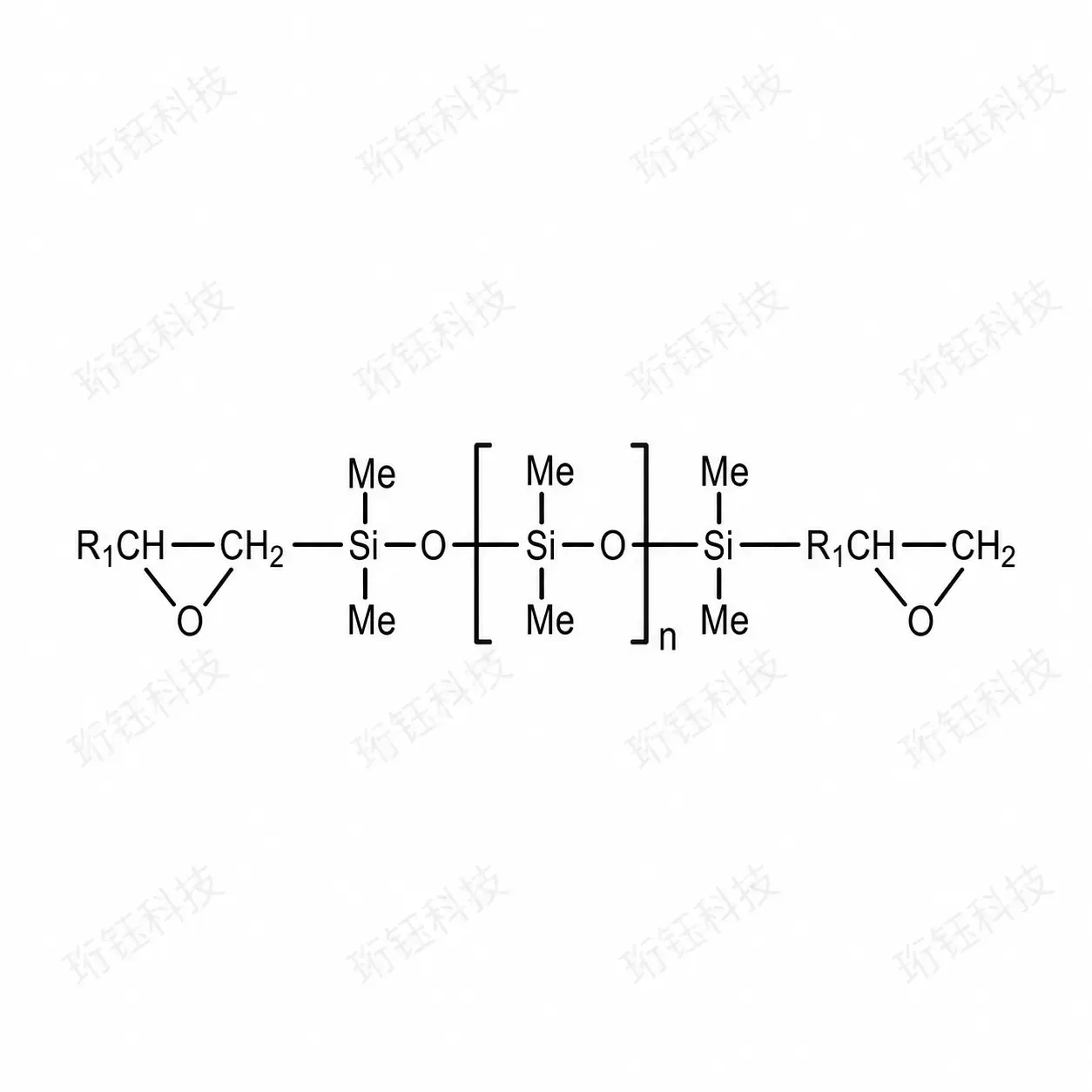
ZG-DSEES Double-End Glycidoxy-Terminated Polydimethylsiloxane
ZG-DSEES contains one glycidoxypropyl reactive end group at each end of the molecular chain, which can simultaneously participate in epoxy ring-opening reactions with amines, anhydrides and carboxyl groups under suitable curing conditions, introducing PDMS flexible segments into the cured network in a two-point manner. The double-end structure can serve as a reactive flexible linking unit for reactive toughening, relieving curing shrinkage and internal stress, and adjusting hydrophobicity, moisture resistance and interfacial performance. Compared with mono-end products, ZG-DSEES is better suited to entering the network structure; its epoxy equivalent must be included in the formulation stoichiometry, and the final dosage should be determined in combination with the target Tg, hardness, toughness and compatibility.
Product positioning: difunctional reactive epoxy silicone modifier for reactive toughening, flexible network construction and interface modification of epoxy resins, structural adhesives, potting, composites and protective coatings
Chemical Type
Double-end glycidoxypropyl-terminated PDMS
Functional Structure
Double-end epoxy; one reactive epoxy group at each end
Reaction Type
Epoxy ring-opening curing/two-point reaction/network construction
Product Form
Colorless transparent liquid
Product Features
Difunctional Reactive Design
The epoxy groups at both ends can simultaneously participate in the curing network, suitable for flexible segment linking, reactive toughening and two-point reactions
Stress Relief and Toughening
PDMS flexible segments can reduce curing internal stress and improve peel/impact and thermal-cycling adaptability
Interface and Moisture Resistance Control
After reactive incorporation, provides a certain degree of hydrophobicity, low surface energy and moisture resistance, and helps reduce free silicone oil migration
Selectable Molecular Weight
Low-molecular-weight models contribute higher epoxy density and network contribution; high-molecular-weight models show more pronounced flexibility and silicone surface effects, but the compatibility window is usually narrower
Typical Technical Specifications
| Model | Nominal Mn (g/mol) | Appearance | Viscosity (25°C, mPa·s) | Epoxy Equivalent (g/eq) | Epoxy Value (mol/100g) |
|---|---|---|---|---|---|
| ZG-DSEES-1300 | 1300 | Colorless transparent liquid | 10-20 | 674 | 0.15 |
| ZG-DSEES-1700 | 1700 | Colorless transparent liquid | 15-30 | 839 | 0.12 |
| ZG-DSEES-2000 | 2300 | Colorless transparent liquid | 35-45 | 1130 | 0.09 |
| ZG-DSEES-3000 | 3000 | Colorless transparent liquid | 40-70 | 1597 | 0.06 |
| ZG-DSEES-4000 | 4000 | Colorless transparent liquid | 70-90 | 2130 | 0.05 |
| ZG-DSEES-10000 | 10000 | Colorless transparent liquid | 500-700 | 10194 | 0.009 |
| ZG-DSEES-20000 | 20000 | Colorless transparent liquid | 2000-5000 | 11973 | 0.008 |
*Epoxy equivalent unit is g/eq; epoxy value (mol/100g) ≈ 100 ÷ epoxy equivalent (g/eq). The above are typical values; the actual batch is subject to the COA.
Applications and Recommended Dosage
| Application System | Recommended Dosage (Engineering Starting Range) |
|---|---|
| Structural Epoxy Adhesives/Composite Adhesives | 2.0%-10.0% based on epoxy resin |
| High-Toughness Epoxy/Elastic Potting and Encapsulation | 5.0%-15.0% based on the base epoxy |
| Epoxy Protective Coatings | 1.0%-5.0% based on epoxy resin |
| Inorganic Filler/Interface-Modified Composite Systems | 1.0%-5.0% based on resin |
Compatibility and Solubility
| Item | Notes |
|---|---|
| Generally preferred | Toluene, xylene, THF, ethyl acetate, butyl acetate; liquid epoxy resins, reactive epoxy diluents and compatible solventborne epoxy systems can serve as preferred pre-mix media |
| Requires lab-trial confirmation | PMA, MEK/MIBK, epoxy resins of different polarity and curing agent phases; the higher the molecular weight, the more important it is to verify transparency, microphase structure and long-term compatibility |
| Generally not recommended for direct use | Highly polar media such as water and low-carbon alcohols; rapid separation may occur in highly polar curing agent phases or waterborne epoxy, so compatibility/emulsification tests should be done first |
| Selection principle | Low-molecular-weight models are preferred for higher epoxy density and network contribution; high-molecular-weight models are preferred for flexibility, hydrophobicity and stress relief, but should be started from a lower dosage |
Note: The data in this document are typical reference values and do not constitute a product specification guarantee. It is recommended to complete applicability verification according to your own formulation, equipment and regulatory requirements.
Packaging, Storage and Safety
Packaging:25 kg, 50 kg, 200 kg plastic drums; other specifications negotiable
Storage:Keep containers sealed and store in a cool, dry, ventilated place, away from moisture, dampness and direct sunlight
Shelf Life:Recommended shelf life of 12 months in unopened conditions
Safety:For transport, handling and personal protection requirements, refer to the corresponding MSDS and local regulations
Technical Manual for Reactive PDMS Series Products
Download the complete product technical manual, including detailed specifications and application guides for ZG-SEES, ZG-DSEES and other reactive PDMS series products