
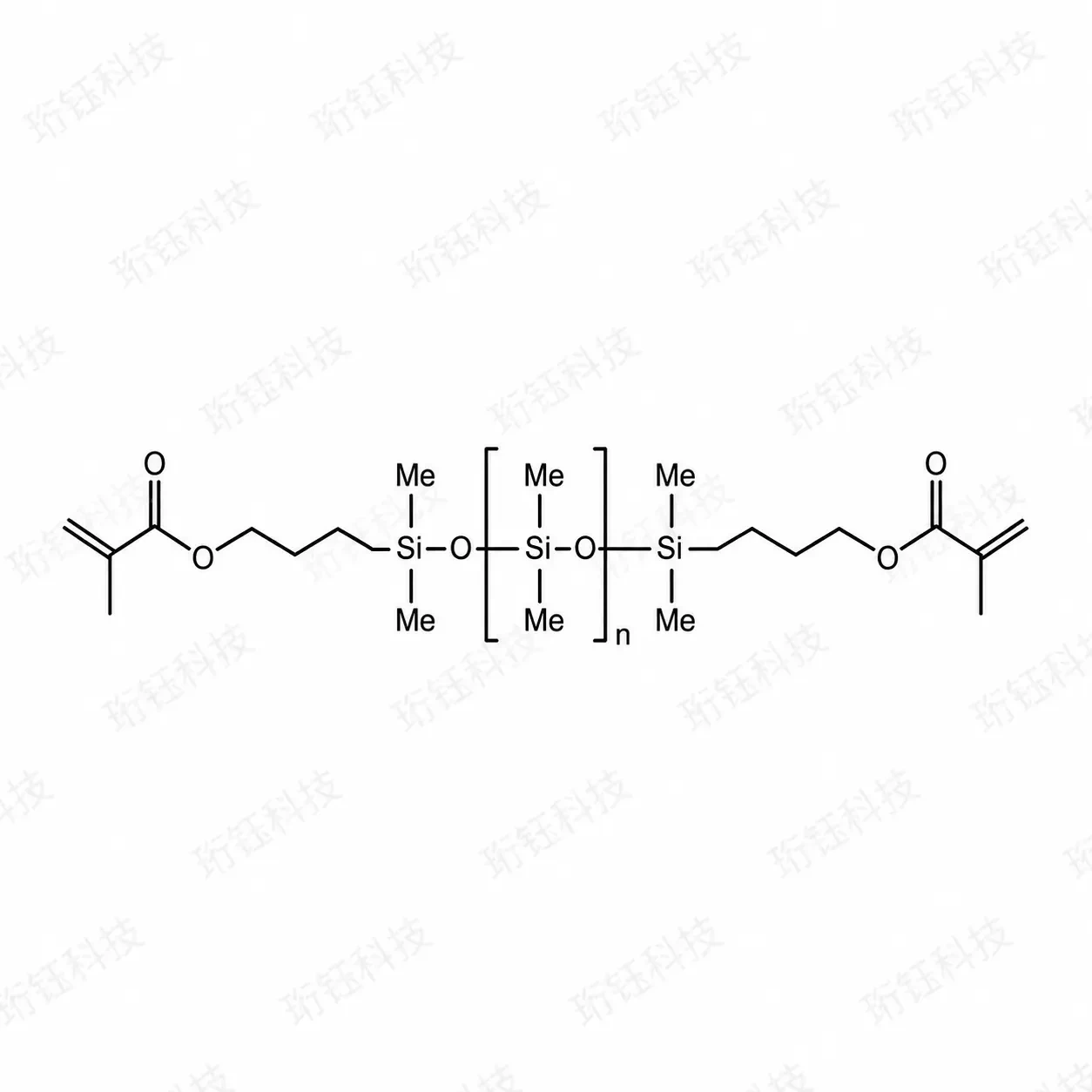
ZG-DSEMMAS Double-End Methacrylate-Functional Polydimethylsiloxane
ZG-DSEMMAS contains polymerizable methacrylate double bonds at both ends of the molecule, and can undergo free-radical copolymerization or crosslinking with acrylates, methacrylates and other vinyl monomers under UV photoinitiation or thermal initiation. The double-end structure allows PDMS segments to be embedded into the polymerization network as flexible bridging units, helping increase the degree of reactive fixation, reduce free silicone oil migration and exudation, and improve flexibility, hydrophobicity, slip, stain resistance and curing internal stress. Compared with mono-end models, ZG-DSEMMAS is better suited to systems requiring two-point reaction, crosslinking toughening and network construction.
Product positioning: difunctional reactive silicone macromonomer for introducing PDMS flexible segments into UV/thermal curing and free-radical polymerization systems and participating in crosslinked network construction
Chemical Type
Double-end methacryloxypropyl-terminated PDMS
CAS
58130-03-3
Reaction Type
Free-radical copolymerization/UV or thermal curing
Product Form
Colorless transparent liquid
Product Features
Double-End Reactive Design
Both ends of the molecule can participate in free-radical reactions, serving as a flexible difunctional crosslinking component to build a network structure containing PDMS segments
Reactive Toughening and Surface Modification
After curing, helps relieve internal stress and improves slip, anti-blocking, hydrophobicity, stain resistance and surface friction performance, while reducing free silicone oil migration
Flexible Segment Bridging
The PDMS backbone can link different polymer segments, balancing curing strength, flexibility and low-temperature performance at appropriate crosslink density
Selectable Molecular Weight
1700/2000 have higher double-bond density and more pronounced reaction efficiency; 3000/4000 balance crosslinking and flexibility; 12000 has more pronounced flexible segments and silicone surface effect, requiring reinforced compatibility and degree-of-cure evaluation
Typical Technical Specifications
| Model | Nominal Mn (g/mol) | Appearance | Viscosity (25°C, mPa·s) | Double-Bond Equivalent* (g/eq) | Double-Bond Content (mmol/g) |
|---|---|---|---|---|---|
| ZG-DSEMMAS-1700 | 1700 | Colorless transparent | 30-60 | 962 | 1.04 |
| ZG-DSEMMAS-2000 | 2000 | Colorless transparent | 30-60 | 1134 | 0.88 |
| ZG-DSEMMAS-3000 | 3000 | Colorless transparent | 50-70 | 1575 | 0.63 |
| ZG-DSEMMAS-4000 | 4000 | Colorless transparent | 40-80 | 2142 | 0.47 |
| ZG-DSEMMAS-12000 | 12000 | Colorless transparent | ≥500 | 6793 | 0.15 |
*Double-bond content is converted from double-bond equivalent: double-bond content (mmol/g) = 1000 ÷ double-bond equivalent (g/eq). Mn is the nominal number-average molecular weight; the specific batch is subject to the COA.
Applications
| Application System | Recommended Dosage |
|---|---|
| Solventborne/Bulk Acrylic Resins | 0.2%-3.0% of total monomers |
| Waterborne Acrylic Emulsions | 0.2%-1.5% of total monomers |
| UV Coatings, Inks, UV-Curing Adhesives | 0.5%-5.0% of the total formulation |
| Synthetic Leather, Fibers and Functional Surface Coatings | 0.5%-5.0% of resin solids |
Compatibility and Solubility
| Category | Notes |
|---|---|
| Generally good compatibility | Toluene, xylene, mineral spirits, low-viscosity siloxanes; generally easy to mix with low-polarity monomers such as BA, BMA and 2-EHA |
| Requires lab-trial confirmation | Butyl acetate, PMA, MEK, MIBK, MMA, IBOA and various acrylic resins; compatibility varies with PDMS molecular weight, resin polarity and the ratio of crosslinking components |
| Generally poor compatibility | Water, methanol, ethanol and highly polar monomers such as high-ratio HEMA, DMAA and NVP. Waterborne systems should use pre-emulsification rather than direct dissolution |
| Selection principle | For priority on reaction efficiency and higher crosslink density, choose 1700/2000; to balance flexibility and crosslinking, choose 3000/4000; for priority on flexibility, hydrophobicity and silicone surface effect, choose 12000 and start from a lower dosage |
Polymerization and UV Curing Notes
Photoinitiator selection:For 395 nm LED systems, prioritize screening TPO-L; BAPO/819 can be dissolved in a compatible acrylate monomer or oligomer before addition. Photoinitiator is typically started at 1%-3% of total polymerizable components, with the actual dosage adjusted according to film thickness, lamp intensity and formulation absorbance
Double-end product characteristics:Double-end products contain on average two polymerizable double bonds and can act as difunctional flexible crosslinking components in network formation; low-molecular-weight grades have higher reactive density, while high-molecular-weight grades should be paired with a compatible reactive diluent or acrylate oligomer during curing to improve compatibility and double-bond conversion
Gelation risk control:In solution or emulsion free-radical polymerization, the double-end functionality increases branching/crosslinking tendency; excessively high local concentration or overdose may cause gelation and rapid viscosity rise. Pre-dilution, slow dropwise addition and lab trials are recommended to determine a safe addition window
Packaging, Storage and Safety
Packaging:25 kg, 50 kg, 200 kg plastic drums; other specifications negotiable
Storage:Recommended storage at 5-25°C in a cool, dry, dark place, away from heat sources, oxidizers and free-radical initiators
Shelf Life:12-month shelf life in unopened conditions
Safety Notes:For transport, handling and personal protection requirements, refer to the corresponding MSDS and local regulations