
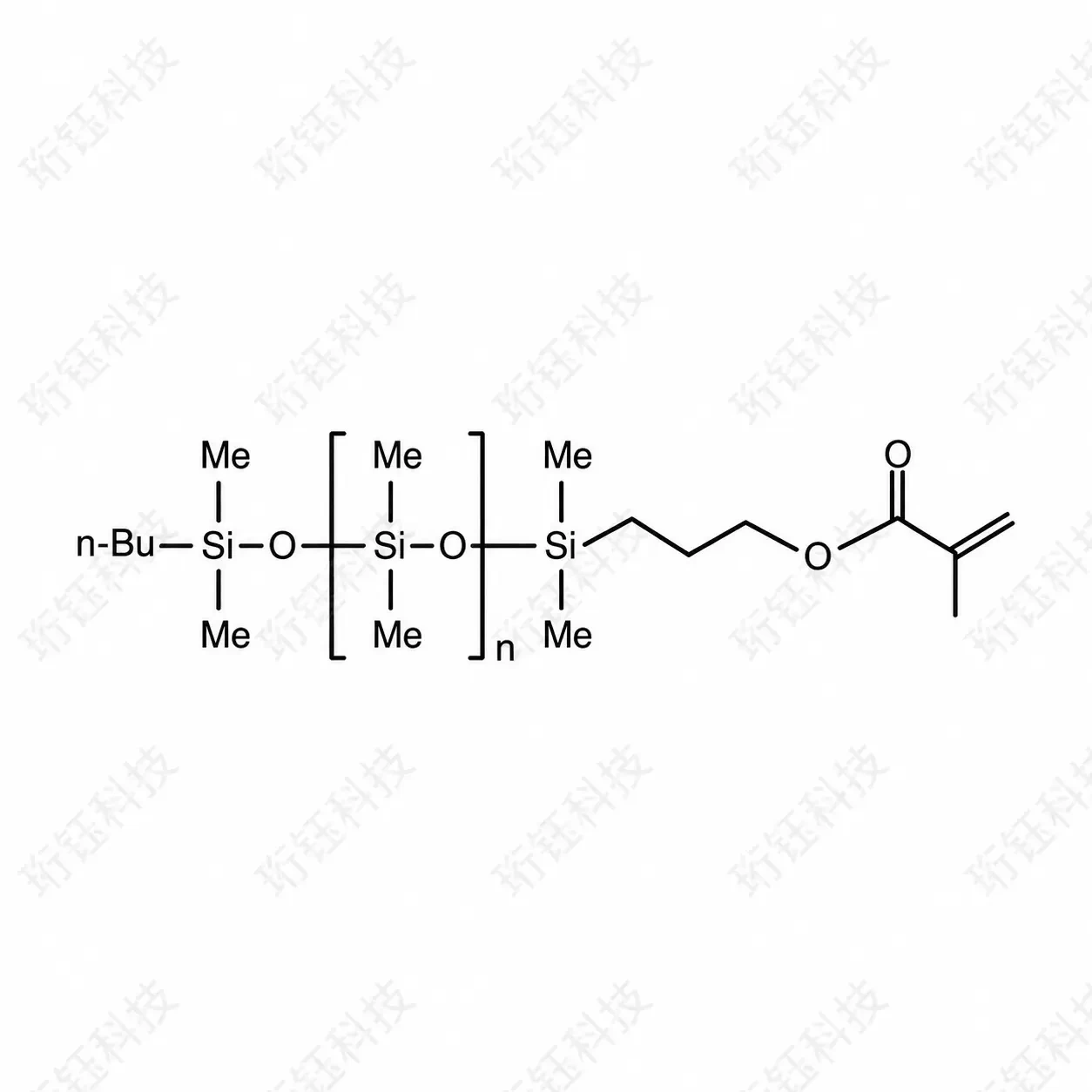
ZG-SEMMAS Mono-End Methacrylate-Functional Polydimethylsiloxane
ZG-SEMMAS contains a polymerizable methacrylate double bond at one end of the molecule, with the other end being a non-reactive capping group. Under UV photoinitiation or thermal initiation, it can undergo free-radical copolymerization with acrylates, methacrylates and other vinyl monomers to form grafted structures with PDMS side chains. Compared with ordinary non-reactive silicone oils, reactive incorporation into the resin helps reduce migration and exudation risks while imparting slip, hydrophobicity, anti-blocking, stain resistance and flexibility control to the system.
Product positioning: monofunctional reactive silicone macromonomer for introducing non-crosslinking PDMS side chains into acrylic/methacrylic resins
Chemical Type
Mono-end methacryloxypropyl-terminated PDMS
CAS
146632-07-7
Reaction Type
Free-radical copolymerization/UV curing
Product Form
Colorless transparent liquid
Product Features
Mono-End Reactive Design
Suited to building graft copolymers with PDMS side chains, helping reduce the risks of crosslinking, gelation and viscosity spikes
Reactive Surface Modification
After curing or polymerization, helps improve slip, anti-blocking, hydrophobicity, stain resistance, leveling and defoaming, and reduces free silicone oil migration
Introduction of Flexible Segments
PDMS segments can relieve internal stress, improve low-temperature flexibility and adjust the surface friction coefficient
Selectable Molecular Weight
Low-molecular-weight grades have relatively higher compatibility and double-bond density; high-molecular-weight grades show a more pronounced silicone surface effect but require reinforced compatibility evaluation
Typical Technical Specifications
| Model | Nominal Mn (g/mol) | Appearance | Viscosity (25°C, mPa·s) | Double-Bond Equivalent* (g/eq) | Double-Bond Content (mmol/g) |
|---|---|---|---|---|---|
| ZG-SEMMAS-1500 | 1500 | Colorless transparent | 12 | Approx. 1490 | 0.67 |
| ZG-SEMMAS-2000 | 2000 | Colorless transparent | 25-35 | Approx. 2080 | 0.48 |
| ZG-SEMMAS-4500 | 4500 | Colorless transparent | 60 | Approx. 4550 | 0.22 |
| ZG-SEMMAS-5000 | 5000 | Colorless transparent | 70 | Approx. 5000 | 0.20 |
*Double-bond equivalent is converted from double-bond content: double-bond equivalent (g/eq) = 1000 ÷ double-bond content (mmol/g). Mn is the nominal number-average molecular weight; the specific batch is subject to the COA.
Applications
| Application System | Recommended Dosage |
|---|---|
| Solventborne/Bulk Acrylic Resins | 0.2%-5.0% of total monomers |
| Waterborne Acrylic Emulsions | 0.2%-2.0% of total monomers |
| UV Coatings, Inks, UV-Curing Adhesives | 0.1%-2.0% of the total formulation |
| Synthetic Leather, Fibers and Functional Surface Coatings | 0.5%-3.0% of resin solids |
Compatibility and Solubility
| Category | Notes |
|---|---|
| Generally good compatibility | Toluene, xylene, mineral spirits, low-viscosity siloxanes; generally easy to mix with low-polarity monomers such as BA, BMA and 2-EHA |
| Requires lab-trial confirmation | Butyl acetate, PMA, MEK, MIBK, MMA, IBOA and various acrylic resins; compatibility varies with PDMS molecular weight and resin polarity |
| Generally poor compatibility | Water, methanol, ethanol and highly polar monomers such as high-ratio HEMA, DMAA and NVP. Waterborne systems should use pre-emulsification rather than direct dissolution |
| Selection principle | For priority on compatibility and reaction efficiency, choose 1500/2000; for priority on strong slip, hydrophobicity and release effect, choose 4500/5000 and start from a lower dosage |
Polymerization and UV Curing Notes
Photoinitiator selection:For 395 nm LED systems, prioritize screening TPO-L, BAPO/819 or corresponding water-dispersible photoinitiators; photoinitiator dosage typically starts at 1%-3% of the reactive components
Mono-end product characteristics:Mono-end products contain on average only one double bond and are mainly used for grafting and surface modification; used alone, they generally cannot form a highly crosslinked network, and should be used together with di-/multi-functional acrylates or reactive resins
Physical blending caution:Post-addition to an already-prepared, non-UV ordinary resin is usually physical blending and cannot be equated with reactive grafting; long-term migration must be verified separately
Packaging, Storage and Safety
Packaging:25 kg, 50 kg, 200 kg plastic drums; other specifications negotiable
Storage:Keep containers sealed and store in a cool, dry, ventilated place at 5-35°C, away from light, heat sources, oxidizers and free-radical initiators
Shelf Life:Recommended shelf life of 12 months in unopened conditions
Safety Notes:For transport, handling and personal protection requirements, refer to the corresponding MSDS and local regulations